
PFAS Well Water Filter Cape Cod
The detection of "Forever Chemicals" in the Cape Cod aquifer is a severe public health concern. We provide MassDEP PFAS6 Water Testing and advanced Point-of-Entry PFAS Removal systems for Barnstable County.
Request Expert Quote
Immediate dispatch available for emergencies.
The "Forever Chemical" Crisis on Cape Cod
Over the past decade, a silent and insidious threat has emerged within the drinking water supplies of Southeastern Massachusetts. Per- and polyfluoroalkyl substances (PFAS) represent a vast class of man-made chemicals that have been utilized since the 1950s in the manufacturing of non-stick cookware, water-repellent clothing, stain-resistant fabrics, and notably, aqueous film-forming foam (AFFF) used in firefighting.
The chemical structure of PFAS involves an incredibly strong carbon-fluorine bond, rendering these compounds virtually indestructible in nature. They do not break down when exposed to sunlight, water, or microbial action. Because of this extreme persistence, they have earned the ominous moniker "forever chemicals."
While PFAS contamination is a national issue, it is a localized crisis for residents of Barnstable County. If you rely on a private residential well for your drinking water on Cape Cod, understanding the threat of PFAS, executing rigorous MassDEP PFAS6 Water Testing, and implementing robust filtration is no longer optional—it is an absolute necessity to protect your family's long-term health.
The Vulnerability of the Cape Cod Aquifer
The hydrogeological makeup of Cape Cod is entirely unique. The entire Cape relies on a single, continuous, unconfined groundwater reservoir known as a sole-source aquifer (comprised of the Sagamore, Monomoy, and other lenses). This aquifer is composed almost entirely of highly porous glacial sand and gravel deposited during the last ice age.
While this sandy geology yields abundant water, it provides virtually zero natural filtration. When rainwater hits the surface, it rapidly percolates directly down into the groundwater table. Consequently, any chemical spilled, sprayed, or buried on the surface of Cape Cod has a direct, unimpeded pathway into the drinking water supply.
This vulnerability has been tragically demonstrated by massive subterranean PFAS contamination plumes originating from local facilities. Decades of utilizing AFFF firefighting foam at locations such as the Barnstable County Fire and Rescue Training Academy in Hyannis, and Joint Base Cape Cod in Bourne and Falmouth, have resulted in heavily concentrated PFAS plumes slowly migrating through the aquifer toward private and municipal wells. Residents in Falmouth, Hyannis, Mashpee, and surrounding areas are particularly at risk, but due to the pervasive nature of these chemicals, no private well on Cape Cod can be considered inherently safe without empirical laboratory testing.
Understanding the MassDEP 20 ppt PFAS6 Standard
Recognizing the severe health implications—which include suppressed immune system response, developmental delays in children, increased risk of certain cancers (kidney and testicular), and interference with natural hormones—the Massachusetts Department of Environmental Protection (MassDEP) instituted aggressive regulatory standards.
MassDEP currently regulates a subgroup of six specific PFAS compounds, collectively referred to as PFAS6. These include PFOS, PFOA, PFHxS, PFNA, PFHpA, and PFDA. The state has established a Maximum Contaminant Level (MCL) of 20 parts per trillion (ppt) for the sum of these six compounds in public drinking water.
To contextualize how incredibly minuscule a part per trillion is: 20 ppt is roughly equivalent to 20 drops of water diluted into an Olympic-sized swimming pool. These chemicals are toxic at astonishingly low concentrations.
Private Well Testing Mandate
While municipal water supplies are mandated by law to test for and remediate PFAS, private residential wells are entirely unregulated by the state once they are drilled. The responsibility to test and treat a private well falls solely on the homeowner. A standard Title 5 real estate transfer water test does not screen for PFAS. You must request a specific MassDEP-certified PFAS6 analysis.
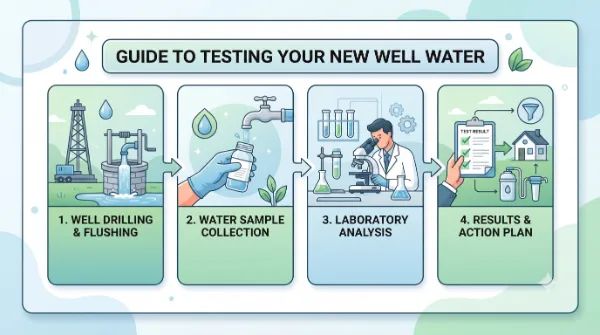
South Mass Water Wells facilitates strict, chain-of-custody MassDEP PFAS6 Water Testing for homeowners across Barnstable and Plymouth Counties. We dispatch technicians to properly draw samples utilizing specialized, PFAS-free equipment (as even the Teflon tape on plumbing fixtures or the technician's waterproof jacket can cross-contaminate a sample) and submit them to a state-certified laboratory for highly sensitive EPA Method 533 or 537.1 analysis.
PFAS Removal Barnstable County: Engineered Solutions
If laboratory results indicate that your well exceeds the 20 ppt threshold (or even if it shows detectable levels below the threshold, given the EPA's recent health advisories suggesting virtually zero exposure is safe), immediate remediation is required. You cannot boil PFAS out of water; boiling actually concentrates the chemicals.
At South Mass Water Wells, we specialize in the design and installation of robust PFAS Well Water Filter Cape Cod systems. Depending on the severity of the contamination and your household's specific water demand, we engineer one of two primary modalities for effective PFAS Removal Barnstable County:
Point of Entry Treatment (POET) GAC Systems
For severe contamination, or to ensure that every single tap, shower, and appliance in the home is protected, we install a Point of Entry Treatment (POET) system in the basement. The gold standard for whole-house PFAS remediation is Granular Activated Carbon (GAC).
A POET GAC system typically consists of two large fiberglass tanks plumbed in a "lead-lag" (series) configuration. The water from your well is forced through millions of microscopic pores within the specialized carbon media. The PFAS molecules physically adhere (adsorb) to the carbon.
The dual-tank system is a critical safety measure. The first ("lead") tank handles the brunt of the contamination. If the carbon in the lead tank becomes saturated and PFAS begins to "break through," the second ("lag") tank acts as a fail-safe barrier, ensuring no contaminated water reaches your faucets. We conduct periodic testing between the tanks; when breakthrough occurs in the lead tank, the media is replaced, and the tank order is rotated.
Point of Use (POU) Reverse Osmosis
If contamination levels are relatively low, and the primary concern is strictly drinking and cooking water, a Point of Use (POU) Reverse Osmosis (RO) system is a highly effective, lower-cost alternative.
Installed directly under the kitchen sink, an RO system forces water through a semi-permeable membrane at high pressure. The microscopic pores in the membrane are small enough to allow water molecules to pass while rejecting the larger PFAS molecules, effectively flushing them down the drain. An RO system is typically paired with pre- and post-carbon block filters to provide exceptionally pure, bottled-water quality drinking water from a dedicated dispenser.
Ongoing Maintenance & Peace of Mind
Installing a PFAS filtration system is not a "set it and forget it" endeavor. The effectiveness of Granular Activated Carbon is finite; once the media is saturated, it can no longer capture PFAS. South Mass Water Wells provides comprehensive, long-term maintenance contracts. We manage the scheduled testing between your lead and lag tanks, execute precise media re-bedding utilizing virgin, high-grade carbon, and ensure your system continues to meet all MassDEP safety thresholds year after year.
Testing & Financial Assistance Updates
Barnstable County currently offers a highly valuable free private well water testing program for Cape Cod residents. If you haven't tested your water recently, taking advantage of this county-funded initiative is an excellent first step.
While MassDEP strongly recommends Point-of-Entry (POE) treatment for affected private wells, there are currently no general statewide homeowner rebates for purchasing or installing these systems. However, if your contamination is linked to a known responsible party—such as a military installation, airport, or fire training facility—you may be eligible for treatment systems or reimbursement through legal settlements or remediation orders. Otherwise, securing your drinking water remains the homeowner's responsibility.
Do not leave your family's health to chance. The "forever chemicals" in the Cape Cod aquifer are a documented reality. Empower yourself with empirical laboratory data and authoritative filtration engineering.
Don't Wait. Test Your Well Water Today.
If your private well on Cape Cod has not been specifically tested for PFAS6, you may be unknowingly exposing your family to toxic chemicals. South Mass Water Wells is your local authority for certified testing and complete whole-house filtration.
Protect Your Family's Health. Call (508) 715-9909 to discuss PFAS Filtration Systems.